
Hazaron Khwahishen Aisi by Mirza Ghalib: Full Ghazal in Urdu, Roman Urdu, and English with Meaning
Hazaron khwahishen aisi is one of the most quoted ghazals in Urdu, and this page gives you the full nine-couplet ghazal by Mirza Ghalib, not just its famous opening line. Many readers also know Hazaaron Khwahishen Aisi through Jagjit Singh’s renowned 1988 rendition. If you want to read the complete ghazal and actually understand it, here is what this page gives you.
- All nine shers, in the order they appear in the Diwan.
- Urdu script, Roman Urdu, and an English rendering for every sher.
- A short, plain meaning under each couplet, including bahut nikle mere armaan lekin phir bhi kam nikle.
- The key words are explained so older vocabulary doesn’t get in the way.
It is meant for readers of Urdu poetry, students, and anyone who has heard the ghazal quoted and wants clear translations and difficult words made simple.
About This Ghazal
Mirza Asadullah Khan Ghalib died in Delhi in 1869. He wrote in Urdu and Persian and thought his Persian work the greater achievement; posterity disagreed, and the Urdu Diwan is the book people still carry. More of his work sits on the site’s Mirza Ghalib poetry page.
Readers searching for a Mirza Ghalib ghazal meaning usually land here, because this is Ghalib’s famous ghazal in Urdu that everyone half remembers. Three things are worth knowing before reading it.
- The radif is nikle: Every sher ends on the same word, meaning came out or left. Ghalib bends it nine ways, from a desire leaving the body to a preacher leaving a tavern.
- The qafiya shifts each time: dam, kam, dam-ba-dam, hum, kham, qalam, Jam, sitam, hum. That repeated sound is why the ghazal is so easy to memorise.
- The mood is not one mood: Each sher stands alone, which is why this ghazal moves from grief to teasing to irony without contradicting itself.
Hazaron Khwahishen Aisi, The Full Ghazal
The nine shers follow the order of the printed Diwan, each with Urdu, Roman Urdu, English, and a short meaning.
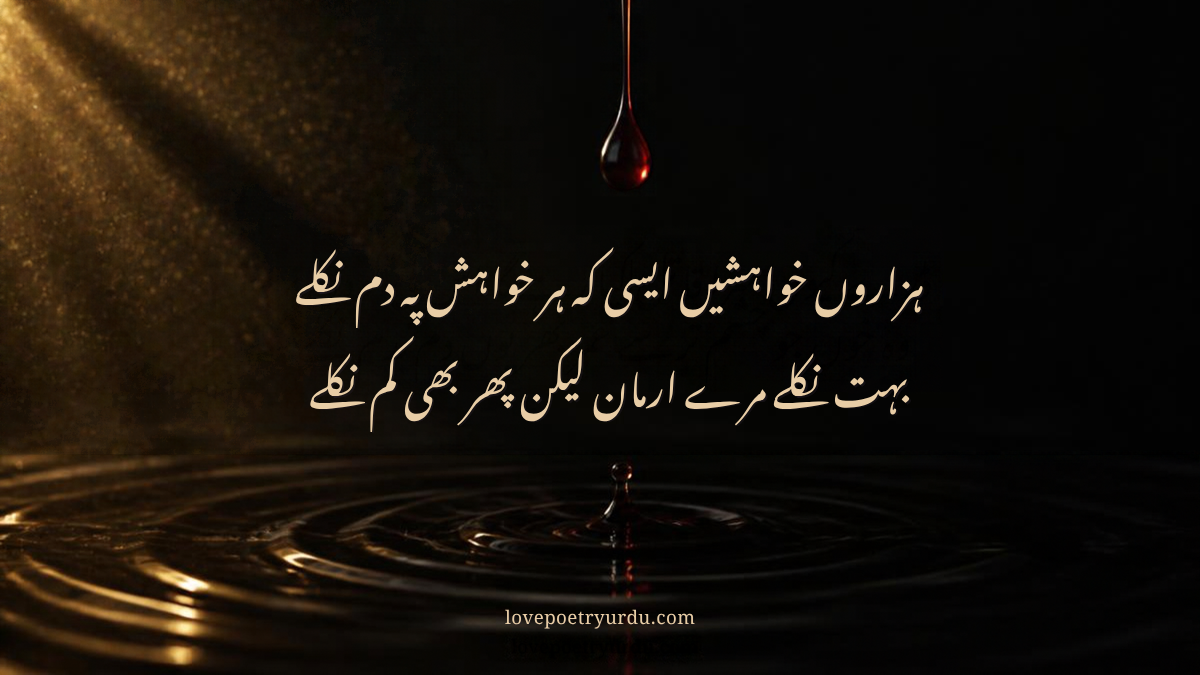
Sher 1: A Thousand Desires (Hazaaron Khwahishen Aisi)
Urdu
ہزاروں خواہشیں ایسی کہ ہر خواہش پہ دم نکلے
بہت نکلے مرے ارمان لیکن پھر بھی کم نکلے
Roman Urdu
Hazaron khwahishen aisi ke har khwahish pe dam nikle
Bahut nikle mere armaan lekin phir bhi kam nikle
English
A thousand desires, and every one of them worth dying for;
Many of mine were granted, and even then they were too few.
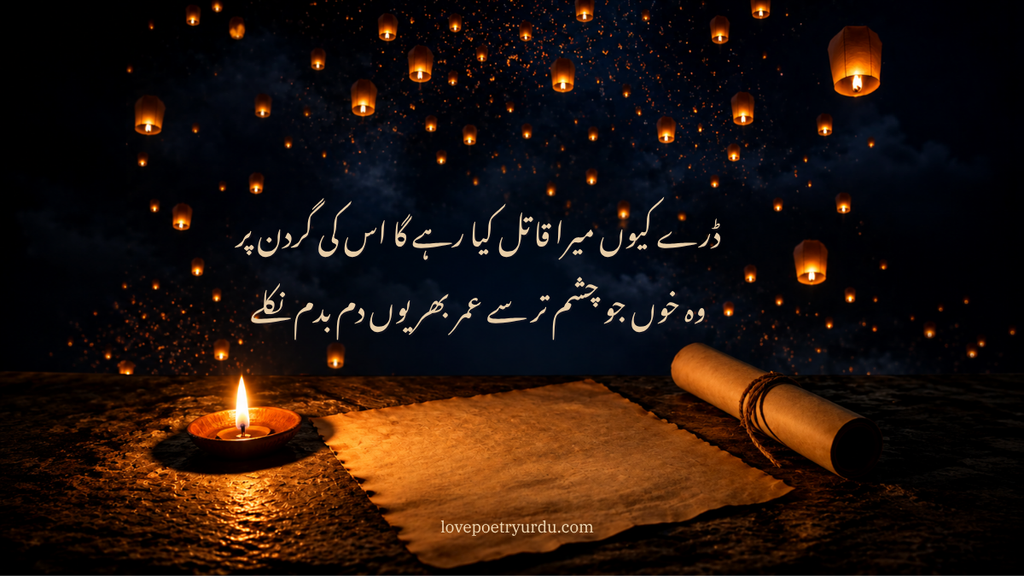
Sher 2: Blood That Left Long Ago
Urdu
ڈرے کیوں میرا قاتل کیا رہے گا اس کی گردن پر
وہ خوں جو چشم تر سے عمر بھر یوں دم بدم نکلے
Roman Urdu
Dare kyun mera qatil, kya rahega us ki gardan par
Woh khoon jo chashm-e-tar se umr bhar yoon dam-ba-dam nikle
English
Why should my killer be afraid? What blood would stay on his neck,
when it left my weeping eyes, drop by drop, all my life?
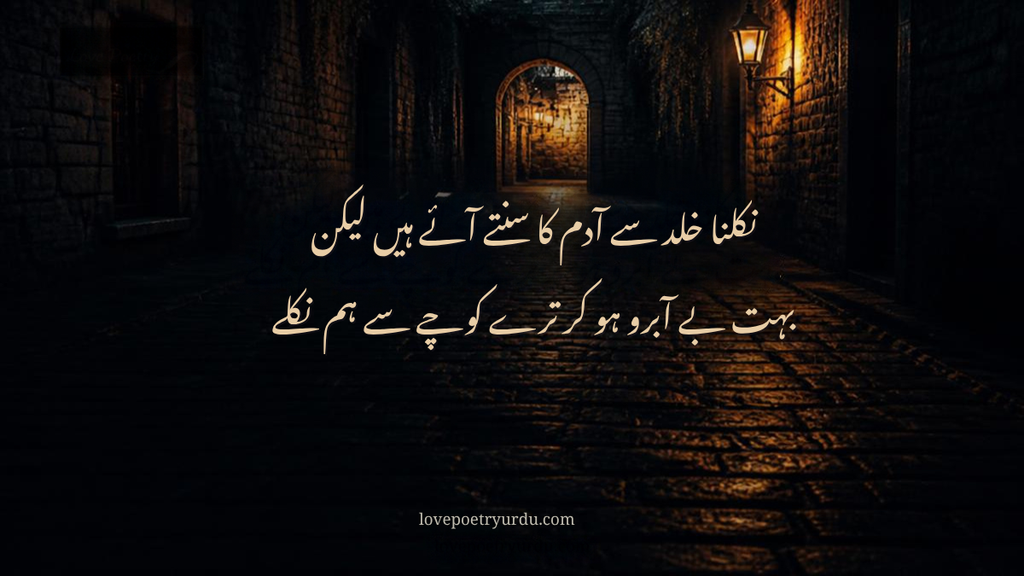
Sher 3: Worse Than Adam’s Exile
Urdu
نکلنا خلد سے آدم کا سنتے آئے ہیں لیکن
بہت بے آبرو ہو کر ترے کوچے سے ہم نکلے
Roman Urdu
Nikalna khuld se Adam ka sunte aaye hain lekin
Bohat be-aabru ho kar tere kooche se hum nikle
English
We have always heard of Adam being turned out of paradise,
but I left your street in far greater disgrace than he did.
The sher compares the lover’s rejection with Adam’s expulsion from heaven, and the phrase se aadam ka sharpens that echo of exile. Here Adam’s banishment is also framed as humiliation, so the speaker’s departure from the beloved’s street feels like a more personal fall from grace.
Sher 4: The Secret of Your Height
Urdu
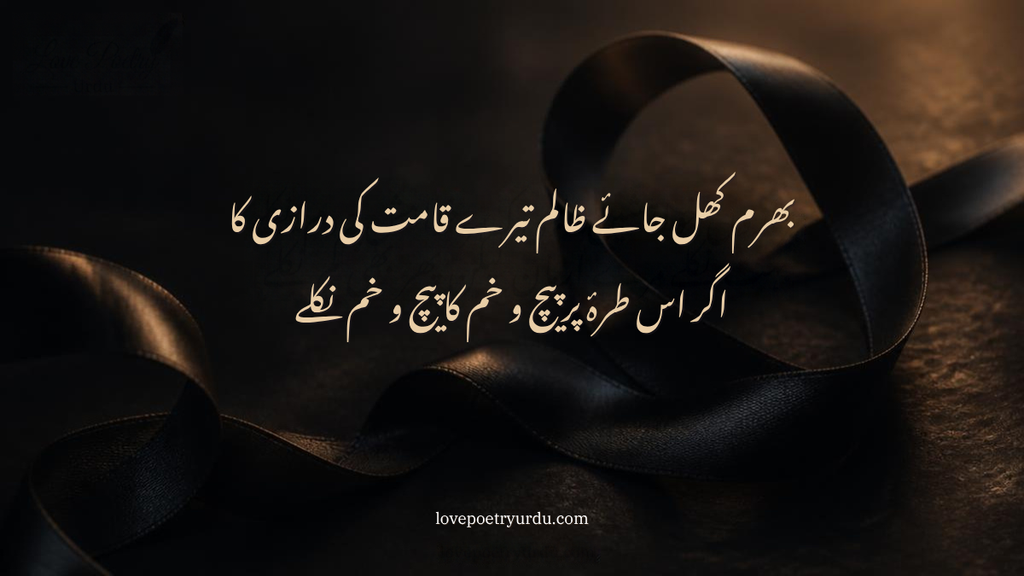
بھرم کھل جائے ظالم تیرے قامت کی درازی کا
اگر اس طرۂ پر پیچ و خم کا پیچ و خم نکلے
Roman Urdu
Bharam khul jaye zalim tere qaamat ki daraazi ka
Agar is turra-e-pur-pech-o-kham ka pech-o-kham nikle
English
The secret of your famous height would be out, cruel one,
if the twists were ever taken out of that curling topknot.
Sher 5: Let Them Have Me Write It
Urdu
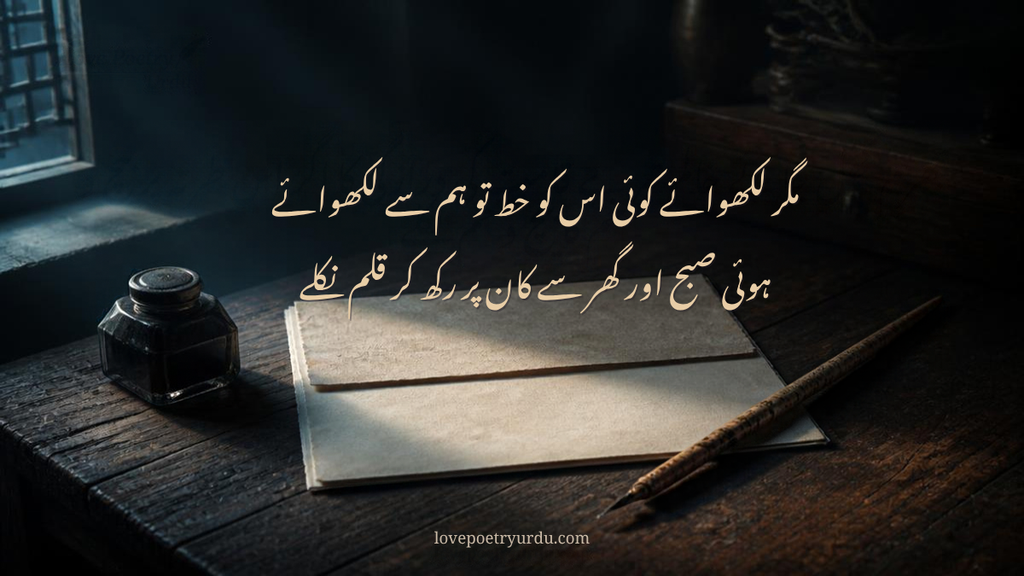
مگر لکھوائے کوئی اس کو خط تو ہم سے لکھوائے
ہوئی صبح اور گھر سے کان پر رکھ کر قلم نکلے
Roman Urdu
Magar likhwaye koi us ko khat to hum se likhwaye
Hui subah aur ghar se kaan par rakh kar qalam nikle
English
If anyone wants a letter written to her, let them have me write it;
morning breaks and I leave the house with the pen behind my ear.
Sher 6: The Cup of Jamshed
Urdu
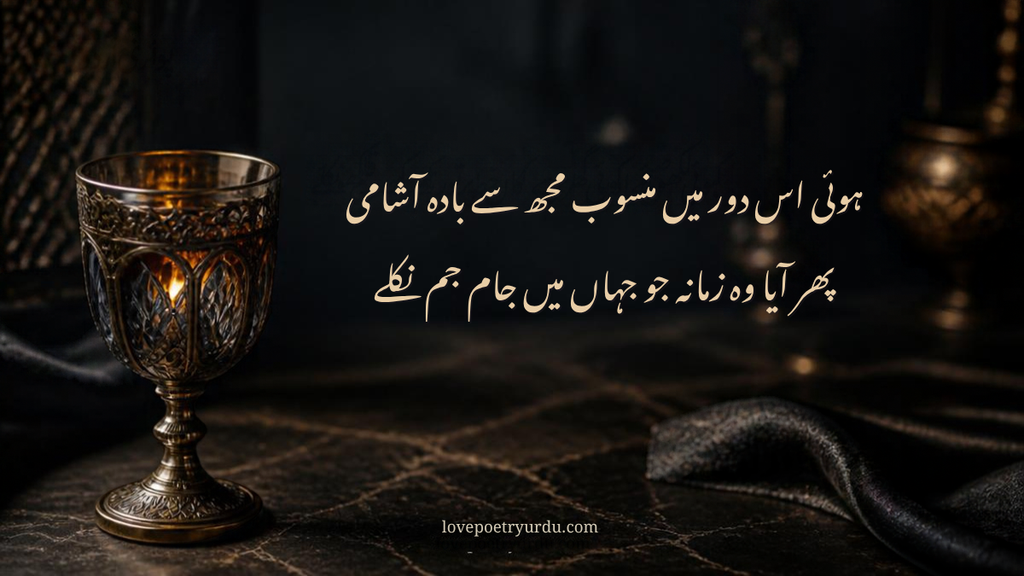
ہوئی اس دور میں منسوب مجھ سے بادہ آشامی
پھر آیا وہ زمانہ جو جہاں میں جام جم نکلے
Roman Urdu
Hui is daur mein mansoob mujh se baada-aashami
Phir aaya woh zamana jo jahan mein jaam-e-Jam nikle
English
In this age the name of wine drinking has been fixed to me,
so the time has come round again when the cup of Jamshed appears.
Sher 7: No Audience for Grief
Urdu
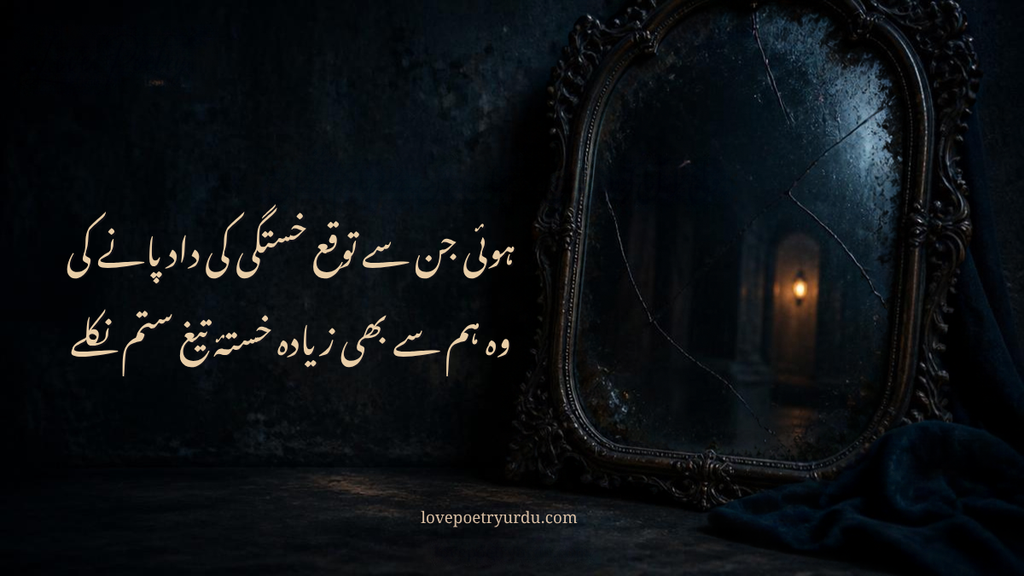
ہوئی جن سے توقع خستگی کی داد پانے کی
وہ ہم سے بھی زیادہ خستۂ تیغ ستم نکلے
Roman Urdu
Hui jin se tawaqqo khastagi ki daad paane ki
Woh hum se bhi ziyada khasta-e-tegh-e-sitam nikle
English
The very people I expected to recognise how broken I was
turned out more broken by the same cruel sword than I.
Sher 8: No Difference Between Living and Dying
Urdu
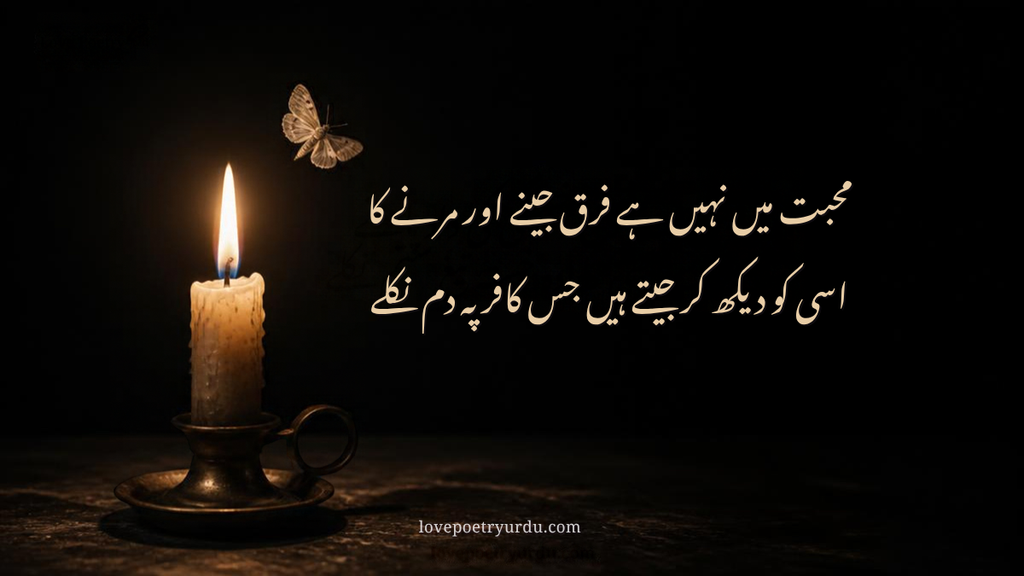
محبت میں نہیں ہے فرق جینے اور مرنے کا
اسی کو دیکھ کر جیتے ہیں جس کافر پہ دم نکلے
Roman Urdu
Mohabbat mein nahin hai farq jeene aur marne ka
Usi ko dekh kar jeete hain jis kaafir pe dam nikle
English
In love there is no difference between living and dying;
we go on living by the sight of the very one who undoes us.
Here Ghalib suggests there is little difference between life and death in love. The beloved, called infidel here as a poetic rendering of kaafir, is not a literal doctrinal label but a figure for the cruel, irresistible one for whom the lover would give everything.
Sher 9: The Preacher at the Tavern Door
Urdu
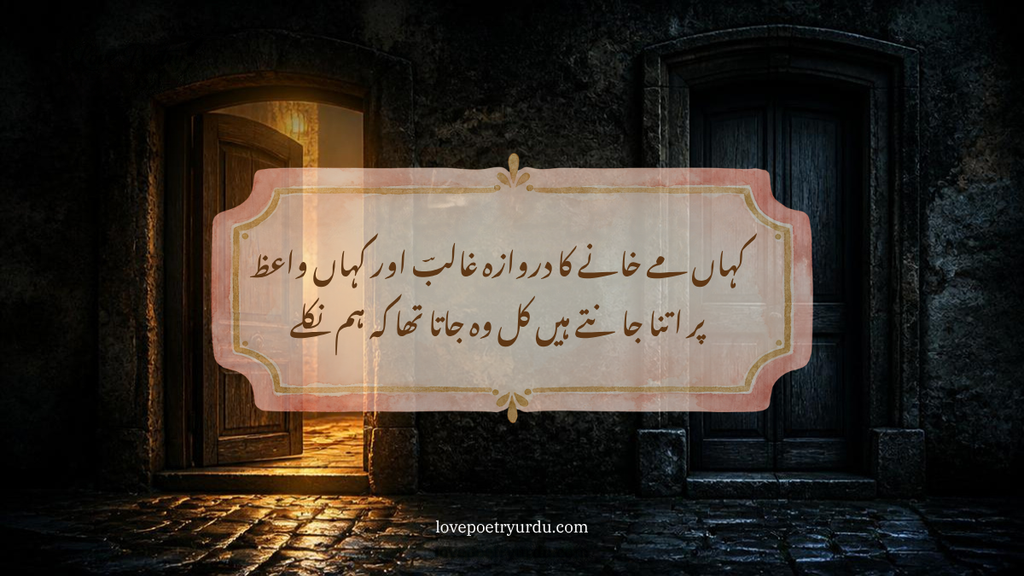
کہاں مے خانے کا دروازہ غالبؔ اور کہاں واعظ
پر اتنا جانتے ہیں کل وہ جاتا تھا کہ ہم نکلے
Roman Urdu
Kahan mai-khane ka darwaza Ghalib aur kahan waiz
Par itna jaante hain kal woh jaata tha ke hum nikle
English
What has the preacher to do with the tavern door, Ghalib?
All I know is that yesterday, as I was coming out, he was going in.
The humor lies in the preacher entering while the speaker is leaving, which exposes religious hypocrisy rather than simply mocking piety. In this irony, the waiz comes off almost like a tyrant of public morality, yet Ghalib quietly undercuts him. The contrast between the mai-khana threshold and a sacred ka darwaaza sharpens the point, as if parda should remain over holy spaces rather than be used to police others while one slips toward the bar.
Key Words Explained
Most of the difficulty here is vocabulary, not meaning. These words unlock it.
- Khwahish: desire or wish. Its plural, khwahishen, opens the ghazal.
- Armaan: a longing held for a long time, closer to a cherished hope than a passing want.
- Dam nikalna: literally for the breath to leave, meaning to die. In the matla, each desire is strong enough to cost a life.
- Chashm-e-tar: a wet eye, the weeping eye of sher 2.
- Khuld: paradise, the garden Adam was turned out of in sher 3.
- Kooche: a lane or street, specifically the street where the beloved lives.
- Turra: a decorative topknot or crest of hair, the subject of the joke in sher 4.
- Jaam-e-Jam: the legendary cup of King Jamshed, in which the whole world could be seen.
- Khasta: wounded, worn down, or broken, used twice in sher 7.
- Waiz: the preacher, the stock figure who condemns wine and the tavern.
Why Is This Ghazal Still Quoted Today?
Readers who meet Ghalib through this ghazal usually stay with him. Nine couplets carry nearly everything his poetry does elsewhere, in language plain enough to send to someone. For shorter verses to share, see the site’s 2-line Urdu shayari collection.
- It names a universal feeling: Wanting more than life can give is not a nineteenth-century problem.
- Each sher stands alone: A reader can take one couplet, send it, and lose nothing.
- The tone shifts without warning: Grief, teasing, and irony sit side by side, so it never feels like a lecture.
- It entered popular culture: The matla has been quoted in films, songs, and speeches for decades, which is why so many know the first line and not the rest.
Ghalib wrote love, loss, and doubt in one breath, which makes him a natural starting point for romantic Urdu poetry.
Conclusion
Hazaron khwahishen aisi deserves to be read past its first couplet. It moves from unfinished desire to Adam’s exile, from a joke about a topknot to a preacher caught at the tavern door. Read it in order once, then keep the sher that stays with you.
Explore more of Ghalib’s work, including his ghazals on love, loss, and the world, on the Mirza Ghalib poetry page.