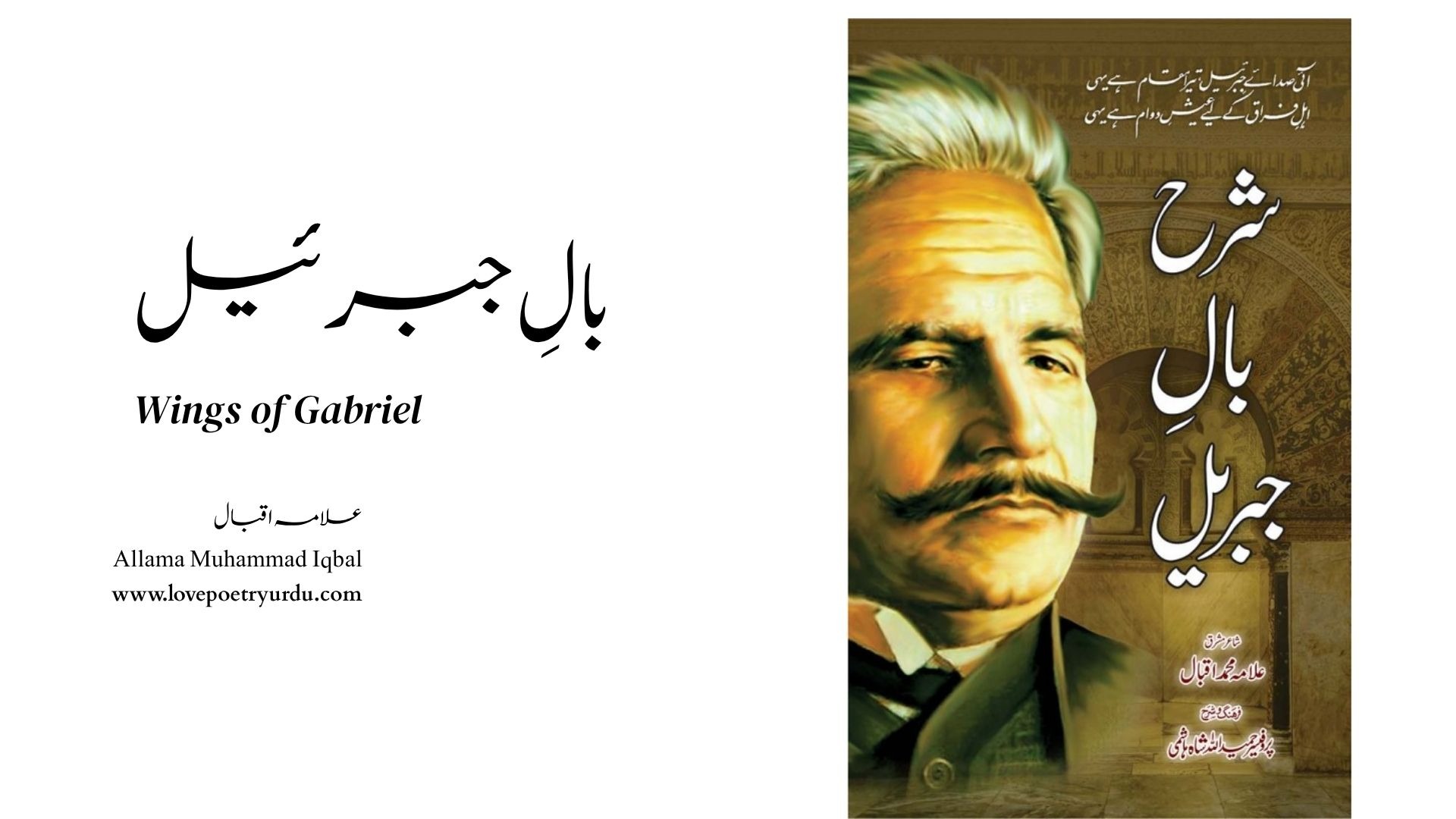
Bal-e-Jibril بالِ جبرئیل
Wings of Gabriel
علامہ محمد اقبال
Allama Muhammad Iqbal
اشاعت ۱۹۳۵ء — لاہور
Published: 1935 — Lahore
خلاصہ — بالِ جبرئیل
بالِ جبرئیل علامہ اقبال کی شاعری کا وہ درخشاں مرحلہ ہے جہاں ان کی فکر اپنی کامل پختگی کو پہنچتی ہے۔ یہ مجموعہ ۱۹۳۵ء میں شائع ہوا اور اسے اقبال کی فکری و روحانی پرواز کا نقطۂ عروج سمجھا جاتا ہے۔
اگر “بانگِ درا” بیداری کی صدا تھی، تو “بالِ جبرئیل” اس بیداری کے بعد کی پرواز ہے۔ یہاں اقبال صرف جگاتے نہیں، بلکہ راستہ بھی دکھاتے ہیں—ایک ایسا راستہ جو خودی، عشق، اور عمل کے ذریعے انسان کو بلندیوں تک لے جاتا ہے۔
“بالِ جبرئیل” کا نام خود ایک گہری علامت رکھتا ہے۔ جبرئیل (Gabriel) وحی لانے والا فرشتہ ہے، اور اس کے پر (بال) علم، نور، اور الہامی بصیرت کی نمائندگی کرتے ہیں۔ گویا یہ کتاب انسان کو اس مقام تک لے جانے کی دعوت ہے جہاں وہ اپنی روحانی حقیقت کو پہچان سکے۔
پہلا پہلو — عشق اور خودی کا امتزاج
اس مجموعے میں اقبال کی فکر کا مرکز “خودی” ہے، لیکن یہ خودی اب محض تصور نہیں بلکہ ایک زندہ حقیقت بن چکی ہے۔ یہاں خودی کو عشق کے ذریعے قوت ملتی ہے۔
اقبال کے نزدیک:
عقل (Aql) محدود ہے
عشق (Ishq) لامحدود ہے
یہی عشق انسان کو حرکت دیتا ہے، خطرات مول لینے کا حوصلہ دیتا ہے، اور اسے عام انسان سے بلند انسان (مردِ مومن) بناتا ہے۔
دوسرا پہلو — شاہین، مردِ مومن اور عمل
“بالِ جبرئیل” میں اقبال کا مثالی کردار مزید واضح ہو جاتا ہے۔
شاہین اب صرف ایک علامت نہیں بلکہ ایک مکمل فلسفہ ہے:
بلند پرواز
خود انحصار
غیر مقلد
خطرات سے بے خوف
اسی طرح “مردِ مومن” کا تصور بھی سامنے آتا ہے—ایک ایسا انسان جو:
ایمان میں پختہ ہو
عمل میں مسلسل ہو
دنیا کو بدلنے کی صلاحیت رکھتا ہو
تیسرا پہلو — مغرب پر تنقید اور مشرق کی بیداری
اقبال اس مجموعے میں مغربی تہذیب پر سخت تنقید کرتے ہیں۔ وہ اسے علم اور طاقت کے باوجود روحانیت سے خالی سمجھتے ہیں۔
ان کے نزدیک:
مغرب نے مادہ کو پایا
لیکن روح کو کھو دیا
اقبال مشرق، خصوصاً مسلمانوں کو دعوت دیتے ہیں کہ وہ اپنی اصل پہچان—روحانیت، ایمان، اور اخلاق—کی طرف لوٹ آئیں۔
بالِ جبرئیل کا لبِ لباب
اس کتاب کا بنیادی پیغام یہ ہے کہ انسان کی اصل طاقت اس کے اندر ہے۔ جب وہ اپنی خودی کو پہچان لیتا ہے اور عشق کو اپنا رہنما بنا لیتا ہے، تو وہ ناممکن کو ممکن بنا سکتا ہے۔
یہ مجموعہ ایک ایسی آواز ہے جو انسان کو کمزوری، تقلید، اور خوف سے نکال کر جرات، تخلیق، اور خود اعتمادی کی طرف لے جاتی ہے۔
Bal-e-Jibril: Wings of Gabriel
Bal-e-Jibril (Wings of Gabriel) is one of the most profound and mature poetry collections by Allama Muhammad Iqbal. Published in 1935, this work represents the peak of Iqbal’s philosophical and spiritual thought.
If Bang-e-Dra was a call to awaken, Bal-e-Jibril is the journey after awakening—the stage where vision transforms into action and belief becomes power.
The title itself is deeply symbolic. Gabriel, the angel of revelation, represents divine knowledge and truth. “Wings” symbolize elevation, movement, and transcendence. Together, the title suggests a spiritual ascent—an invitation for humanity to rise above limitations and rediscover its divine potential.
Historical and Literary Background
The early 1930s were a period of immense personal and political significance for Iqbal. He had recently returned from the Round Table Conferences in London (1931–1932), where he observed the complexities of global power politics firsthand.
During this era, he also traveled to Spain, visiting the Great Mosque of Córdoba. Standing in the ruins of a lost Islamic civilization, Iqbal didn’t just feel sorrow; he felt a surge of creative energy. He realized that while empires fall, the “Spirit of Art” fueled by Ishq (Love) remains eternal. Additionally, his 1933 visit to Afghanistan at the invitation of King Nadir Shah further solidified his vision of a unified, spiritually awakened East.
Literally, Bal-e-Jibril was Iqbal’s response to the growing influence of Marxism, Atheism, and Western Secularism in India. He felt the youth needed more than just “patriotic songs”—they needed a metaphysical anchor to survive the coming storms of the 20th century.
The Core Philosophical Concepts
In Bal-e-Jibril, Iqbal moves beyond simple metaphors into a structured system of thought.
- The Concept of Faqr (Spiritual Sovereignty): Unlike the Western concept of the “Superman” based on power, Iqbal’s ideal man is the Faqir. This isn’t a beggar, but a person so self-sufficient that they do not bow to worldly masters.
- The Supremacy of Ishq (Passion) over Aql (Intellect): Iqbal argues that while Aql is a useful tool for science and logic, it is cautious and limited. Ishq, however, is a fearless, creative force that allows a human to perform miracles and transcend time.
- Zarb-e-Kaleem (The Stroke of Moses): Though this later became the title of another book, the seeds are here. It represents the power of the “Truth” to shatter the “Falsehood” of modern materialistic idols.
Detailed Summary
The book is masterfully organized into several distinct sections, each serving a different spiritual purpose:
- The Ghazals (Part 1 & 2): These are the heart of the book. Unlike traditional Urdu ghazals that focus on human romance, Iqbal’s ghazals are a dialogue between the “Self” and “The Creator.” They are filled with themes of longing, rebellion, and spiritual pride.
- The Masterpiece Poems: This includes Masjid-e-Qurtuba (The Mosque of Córdoba), which many critics call the greatest poem in the Urdu language. It explores the philosophy of Time (Waqt) and the immortality of the soul.
- Saqi-Nama (The Book of the Wine-Server): Written during his stay in the mountains of Afghanistan, this poem is a call for a “New Wine” (New Knowledge/Spirit) for the youth. It traces the history of life from the primordial spark to the modern human.
- The Gabriel and Satan Dialogue: In poems like Jibril-o-Iblees, Iqbal creates a dramatic debate to show that even “Evil” is a force that tests and eventually strengthens the human will.
Poetic Style: The Sound of Gabriel’s Wing
The style of Bal-e-Jibril is markedly different from Bang-e-Dra. It is more “Persianized,” more rhythmic, and far more assertive.
1. Architectural Precision
Iqbal’s verses in this book are like the architecture of the Mosque of Córdoba—strong, symmetrical, and grand. There is no “extra” word; every syllable is placed to create a specific emotional resonance.
2. Symbolic Metaphors (The Bestiary of the Spirit)
Iqbal uses nature not for beauty, but for instruction:
- The Shaheen (Falcon): Represents high-mindedness, independence, and the refusal to build a “nest” (complacency).
- The Jugnu (Firefly): Represents the small but persistent light of the individual “Self” in a dark world.
- The Kohistan (Mountains): Represents the hardship required to breed greatness.
3. The “Urdu-Persian” Synthesis
In this collection, Iqbal seamlessly blends high Persian vocabulary with Urdu grammar. This creates a “Diction of Power” (Lajpaal Lehja) that sounds like a command. The rhythm of his Ghazals is often compared to the beating of wings or the galloping of a horse—fast-paced and high-energy.
Selected Ash‘ar with Analysis
Shair=1
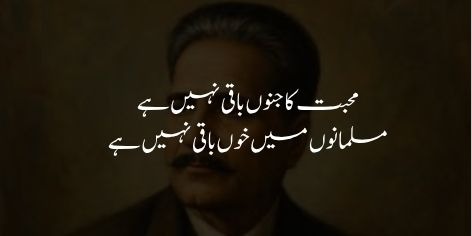
محبت کا جنوں باقی نہیں ہے
مسلمانوں میں خوں باقی نہیں ہے
(Muhabbat ka junoon baqi nahi hai
Musalmanon mein khoon baqi nahi hai)
Analysis: Here, Iqbal laments the spiritual decay of the community. “Muhabbat” (Love/Ishq) is the engine of life. He argues that the “blood” (energy/life force) has gone cold because the fire of madness (Junoon) for a higher cause has been replaced by complacency and fear.
Shair=2
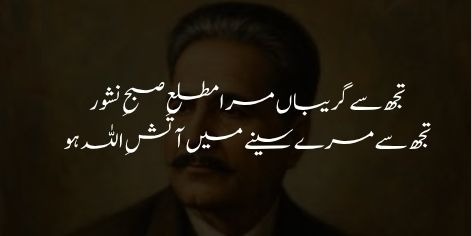
تجھ سے گریباں مرا مطلعِ صبحِ نشور
تجھ سے مرے سینے میں آتشِ اللہ ہو
(Tujh se gareebaan mera matla-e-subh-e-nashoor
Tujh se mere seene mein aatish-e-Allah Hu)
Analysis: This verse is a direct address to the Divine or the spiritual guide. He says his “torn collar” (the sign of a lover’s madness) is actually the dawn of a new awakening (Subh-e-Nashoor). The internal fire of “Allah Hu” (The Breath of God) is what illuminates his heart and gives him the courage to stand against the world.
Shair=3
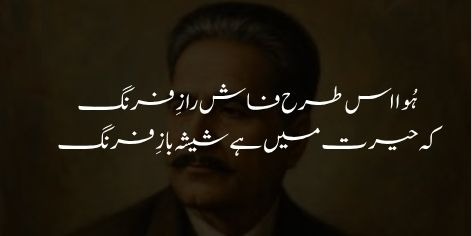
ہُوا اس طرح فاش رازِ فرنگ
کہ حیرت میں ہے شیشہ بازِ فرنگ
(Hua is tarah faash raaz-e-Farang
Ke hairat mein hai sheesha-baz-e-Farang)
Analysis: Writing during the colonial era, Iqbal claims he has decoded the secret of Western power (Farang). He realized it was built on “glassware”—fragile, materialistic, and deceptive. Even the clever politicians of the West (the Sheesha-baz) are shocked that an Eastern poet has seen through their illusions.
Shair=4
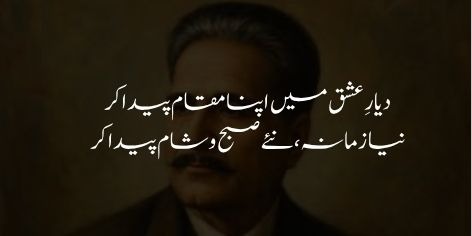
دیارِ عشق میں اپنا مقام پیدا کر
نیا زمانہ، نئے صبح و شام پیدا کر
(Diyar-e-Ishq mein apna maqaam paida kar
Naya zamana, naye subh-o-shaam paida kar)
Analysis: This is an anthem for creativity. Iqbal tells the seeker not to accept the world as it is. In the “Realm of Love,” you must carve out your own status. He urges the youth to be so powerful that they create their own “new era” and their own “mornings and evenings.”
Shair=5
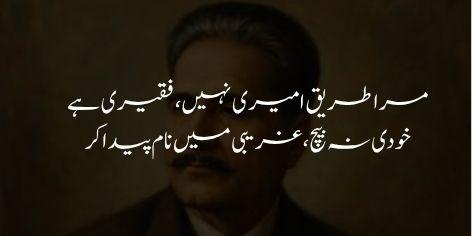
مرا طریق امیری نہیں، فقیری ہے
خودی نہ بیچ، غریبی میں نام پیدا کر
(Mera tareeq ameeri nahi, faqeeri hai
Khudi na bech, ghareebi mein naam paida kar)
Analysis: One of his most iconic lines on Khudi. He defines his path as Faqeeri (spiritual sovereignty). He warns: never trade your self-respect (Khudi) for worldly wealth. It is better to be physically poor but spiritually “wealthy” and famous for your integrity.
Shair=6
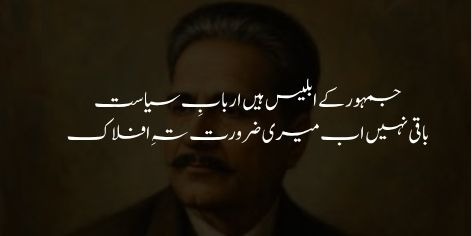
جمہور کے ابلیس ہیں اربابِ سیاست
باقی نہیں اب میری ضرورت تہِ افلاک
(Jamhoor ke Iblees hain arbab-e-siyasat
Baqi nahi ab meri zaroorat teh-e-aflaak)
Analysis: A biting critique of the politicians of his time. He calls the masters of politics the “Satan (Iblees) of the masses.” He feels that in a world where truth is sacrificed for votes and power, a visionary poet like him might no longer be “needed” under the skies, yet his message remains a necessary warning.
Shair=7
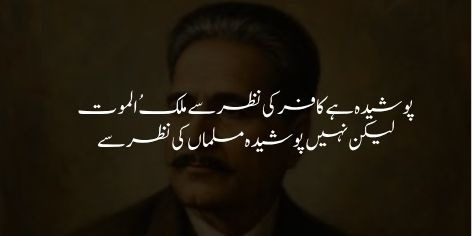
پوشیدہ ہے کافر کی نظر سے ملکُ الموت
لیکن نہیں پوشیدہ مسلماں کی نظر سے
(Poshida hai kafir ki nazar se Malak-ul-Maut
Lekin nahi poshida Musalman ki nazar se)
Analysis: This verse deals with the fear of death. For one who denies the soul (Kafir), the Angel of Death is a hidden, terrifying mystery because they only value the material life. But for a true believer (Musalman), death is not hidden; it is a known transition, a “meeting” that they are prepared for because they have looked beyond the physical world.
نتیجہ (Conclusion)
بالِ جبریل انسانی عظمت اور خودی کی بلندی کا وہ شاہکار ہے جہاں علامہ اقبال کا فلسفہ اپنے عروج پر نظر آتا ہے۔ یہ کتاب محض شاعری نہیں بلکہ ایک عملِ پیہم کی دعوت ہے۔ اس میں اقبال نے بتایا ہے کہ اگر انسان اپنی “خودی” کو پہچان لے اور “عشق” کو اپنا رہنما بنا لے، تو وہ تقدیر کا قیدی نہیں بلکہ اس کا خالق بن جاتا ہے۔ یہ مجموعہ ہمیں سکھاتا ہے کہ فقیری میں بھی شاہانہ وقار کیسے برقرار رکھا جاتا ہے اور یہ کہ ایک مومن کی نگاہ موت کے خوف سے آزاد ہوتی ہے۔
Roman Urdu: Khulasa
Bal-e-Jibril insani azmat aur buland-parwazi ka ek mukammal manshoor hai. Is kitab mein Iqbal ne insaan ko us ki haqiqi taqat ka ehsas dilaya hai. Unhon ne bataya ke “Faqr” aur “Ishq” ke zariye ek mumin kainat ki taqdeer badal sakta hai. Yeh kitab maghribi maddah-parasti (materialism) par kadi tanqeed karti hai aur musalmanon ko dobara “Shaheen” ban’ne ki dawat deti hai taakay woh sitaron se agay ke jahanon ko taskheer kar sakein.
Conclusion: English
Bal-e-Jibril is the definitive manifesto of human dignity. It is divided into Ghazals and long poems (like Saqi-Nama and Masjid-e-Qurtuba) that challenge the reader to transcend their limitations. The book argues that through the cultivation of Khudi and the fire of Ishq, a human can reach a station where even the angels are left behind. It is a critique of modern politics and a celebration of spiritual independence.